Bringing dog food into the United States
Bringing dog food into the United States: why kibble counts as an agricultural product, what customs allow, and how to declare it on arrival.
By the Loulou Air team · · 8 min read
Your dog’s bag of kibble is not ordinary baggage when you land in the United States. It is an agricultural product, inspected like any meat you might be carrying, it must be declared, and its entry is never guaranteed. Here is what the three agencies involved actually say: US Customs and Border Protection, USDA’s APHIS, and the FDA.
Can you bring your dog’s food into the United States?
Not freely, and never without declaring it. CBP states that all travelers entering the United States are required to declare meats, fruits, vegetables, plants, seeds, soil, animals, as well as plant and animal products they may be carrying. Dog food falls into that last category, because it is made from animal material.
APHIS, the animal and plant health service of the US Department of Agriculture, says the same: travelers entering the United States must declare all agricultural and wildlife products to US Customs and Border Protection officials, and those officials decide whether the products can enter. Note the order of things: declaring is mandatory in every case, admission is decided on arrival.
Why does kibble count as an agricultural product?
Because it contains meat, and meat is the most closely watched material at the US border. CBP is explicit: you may not import fresh, dried or canned meats or meat products from most foreign countries into the United States, and you may not import food products prepared with meat either.
The rule follows the ingredients, not just the finished product. CBP explains that a product containing meat from a restricted country is usually prohibited as well, and gives beef broth as its example. Dog food based on beef, pork, lamb or poultry follows the same logic.
Origin matters as much as the nature of the product. APHIS does not allow travellers to bring back most cattle, swine, sheep or goat meat from countries affected by foot-and-mouth disease, bovine spongiform encephalopathy, swine vesicular disease, classical swine fever or African swine fever, nor most poultry meat from countries affected by highly pathogenic avian influenza or Newcastle disease. European travellers are directly concerned: the same page states that cured hams and salami from areas within France, Germany, Italy and Spain are barred for travellers, and may only enter in commercial shipments.
How do you declare dog food on arrival?
By ticking a box, before you even meet an officer. CBP asks travellers to always declare agricultural items by checking “Yes” on Question 11 of CBP Declaration Form 6059B, and states that the declaration must cover everything carried in checked baggage, carry-on luggage or a vehicle. That form is the customs declaration form you must complete on entry.
What happens next depends on the inspection. CBP states that all agriculture items are subject to inspection by a CBP agriculture specialist at ports of entry, and that a declared item in non-commercial quantities which turns out to be prohibited can be abandoned at the port of entry if the traveller wishes to continue into the country.
Not declaring costs twice over. Undeclared prohibited items are confiscated and disposed of by CBP agriculture specialists, and the agency adds that civil penalties may be assessed for failure to declare, up to $1,000 per first-time offense for non-commercial quantities. Its Know Before You Go page puts the standard figure at $300 for first-time offenders and $500 for a second violation.
Declaring, by contrast, protects you: APHIS states that as long as you declare all agricultural products to CBP officials, you will not face any penalties, even if an inspector determines that the items cannot enter the country. You risk losing the bag, not paying a fine.
Do you need a permit for your dog’s food?
Often, yes, as soon as it contains animal material. The FDA states that a USDA APHIS Veterinary Services permit is required for the importation of any animal food containing animal origin material from countries with livestock diseases exotic to the United States. APHIS puts it more broadly still: generally, you need a VS permit for materials derived from animals or exposed to animal-source materials.
The same service says where to check your own case: its online tool, the VS Permitting Assistant, has the most updated and comprehensive information on which products do or do not require a permit. Have the list of animal-origin ingredients and the country of origin ready before you use it. A permit exempts you from nothing on arrival: APHIS notes that customs review all imported animal products at the port of entry, including those that need no import permit.
Posting the food ahead of you makes matters worse, not better: APHIS treats commodities sent by mail as “commercial” use, while “personal” use covers what is in a passenger’s baggage or vehicle. Importer obligations then apply, including the FDA’s prior notice for each shipment of imported food before it arrives.
Are treats, chews and antlers allowed?
Some are, on precise conditions that APHIS lists. Plain rawhide intended for use as pet chews or treats enters without a Veterinary Services permit provided it is not ground, flavoured, basted, coloured or otherwise processed. APHIS defines that rawhide as untanned cattle skin: a product that does not match the description requires a permit.
Antlers follow a similar rule. Plain, naturally shed antlers, unground, unpowdered and unflavoured, are allowed without a permit if they come from a region free of foot-and-mouth disease and rinderpest, and are accompanied by an original health certificate signed by a full-time salaried veterinarian of the exporting region’s animal health agency. A certificate from your own vet is not enough.
How much food can you bring?
For meat products, APHIS sets a clear ceiling: travellers may not bring more than 50 pounds of an item, roughly 22.7 kilos; beyond that, the shipment counts as commercial and falls to another USDA service.
For dog food, the only figures APHIS publishes concern Canada: food, treats and chews must be in unopened retail packaging, raw, dehydrated, freeze-dried or sun-dried items must be labelled as a product of Canada or the US, and the limit is 50 lb per vehicle by land, 20 lb per family by air. APHIS adds that it may impose temporary restrictions when certain livestock or poultry diseases are present in North America.
Flying in from Europe, no weight limit specific to dog food is published: what decides the outcome is the origin of the ingredients and the permit, not the size of the bag.
What should you do before you fly?
Pack the ration for the journey and arrange supply at the other end, because the fate of your bag is decided on arrival.
Three useful habits, all drawn from the official pages. Keep original packaging and receipts: APHIS advises holding on to them as proof of country of origin, alongside the product label, proof of travel or a certificate of origin. Check your exact product in the VS Permitting Assistant before it goes in the suitcase. And declare everything, including anything you are unsure about.
Switching a dog’s food abruptly is not a small matter: our article on dog jet lag sets out what veterinary sources say about keeping the usual ration. If your dog is on a particular diet, talk to your vet and look together for an equivalent available in the United States.
The rest of the file is covered elsewhere: the document your dog itself needs is set out in our article on the CDC Dog Import Form and on our United States travel requirements page, and the full packing list is in what to pack for your dog abroad. Other destinations are covered in our travel requirements pages.
Who checks your dog’s file before the flight?
Our brokers do: they check every dog’s file before departure, entry documents included. Travel requirements apply on every flight, private ones included, so neither the customs declaration for the food nor the form required for your dog disappears because you fly private.
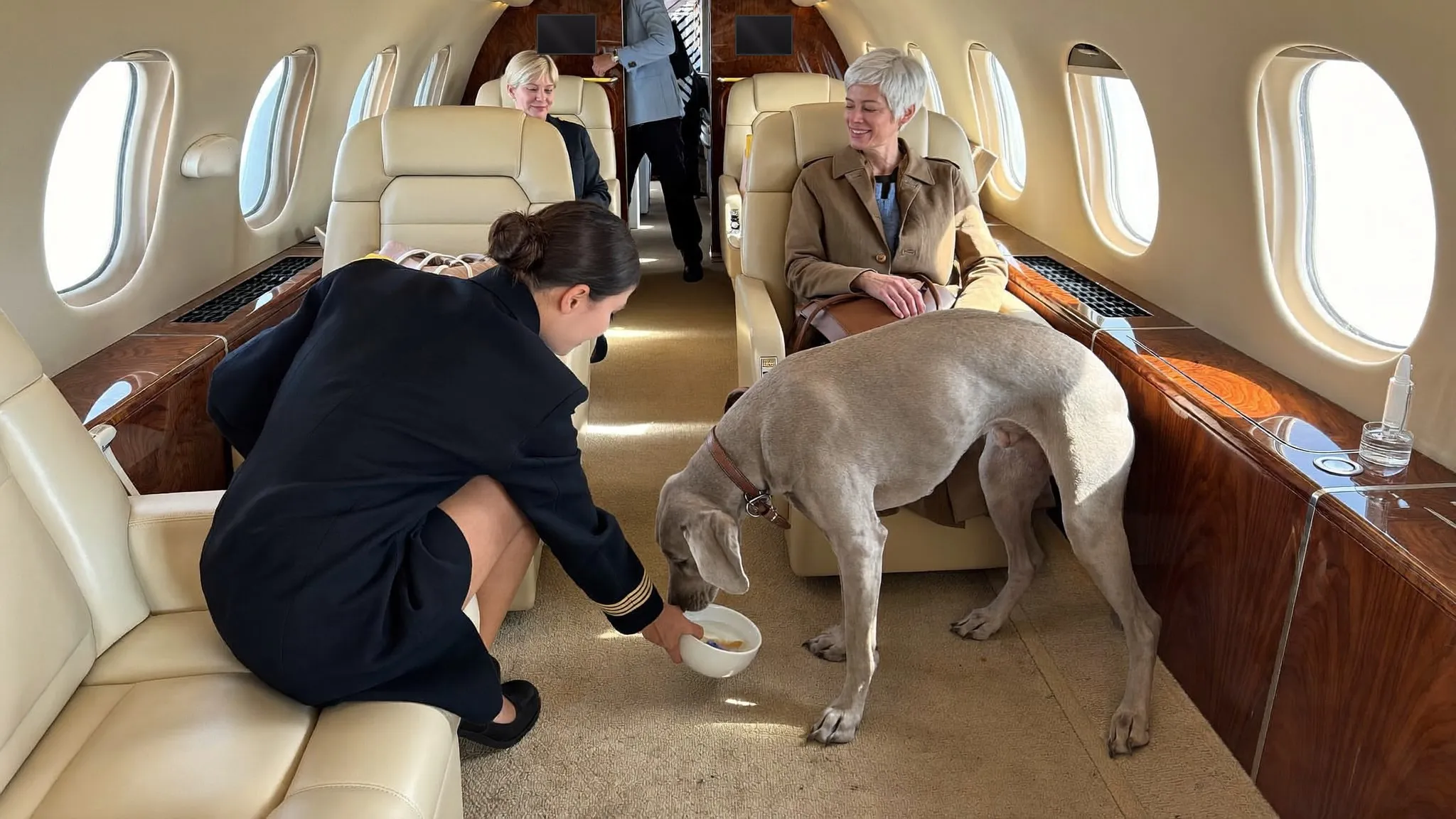
Loulou Air is an AEROAFFAIRES brand, a private aviation broker since 1991, and sells Pay-per-Seat private jets for your dog and you: you pay for your seat, not the jet, and one ticket covers one person and their dog. Your dog flies in the cabin with you, never in the hold, and stays at your feet for the whole flight. There is none of the weight limit imposed by scheduled airlines, because your dog does not travel in the hold: capacity depends on the aircraft and the number of animals on board, and a broker confirms each dog case by case. On board, the crew is briefed on welcoming animals, and water, bowls and blankets are provided.
Our flights serve New York: see the flights to New York, or speak to a broker about your dog’s file and its food.
Frequently asked questions
Can you pack kibble in your suitcase for the United States?
You can pack it, but you must declare it, and its entry is not guaranteed. CBP requires all animal products to be declared, by checking “Yes” on Question 11 of Form 6059B, and prohibits imports of meat products from most foreign countries. A declared item that is then refused is abandoned at the port of entry, with no penalty.
What is the penalty for not declaring dog food?
CBP puts the civil penalty at $300 for a first-time offender and $500 for a second violation, while its agricultural products page mentions penalties of up to $1,000 per first-time offense for non-commercial quantities. Undeclared prohibited items are confiscated and disposed of on top of that.
Can you have your dog’s food shipped instead?
That is not simpler. APHIS regulates commodities sent by mail as “commercial” rather than personal use, which triggers importer obligations: a Veterinary Services permit depending on the product, and, on the FDA side, prior notice for each shipment of imported food.
Sources
Rules change: check them against these sources before every trip.
- USDA APHIS - Traveling From Another Country
- USDA APHIS - Traveling With Food or Agricultural Products
- USDA APHIS - International Traveler: Meats, Poultry, and Seafood
- USDA APHIS - Traveling into the United States From Canada at Land Borders
- USDA APHIS - Animal Product Imports
- USDA APHIS - Guidelines: Animal Products That Do Not Require Import Permit
- U.S. Customs and Border Protection - Bringing Agricultural Products Into the United States
- U.S. Customs and Border Protection - Prohibited and Restricted Items
- U.S. Customs and Border Protection - Bringing Food into the U.S.
- U.S. Customs and Border Protection - Traveler Entry Forms
- FDA - Importing Animal Food