What to pack for your dog: the checklist
What to pack for a dog travelling abroad: the documents that come first, what customs accept as food, the travel crate, the bowls and the ID tags.
By the Loulou Air team · · 8 min read

Your dog’s luggage comes down to four things: the paperwork, the travel container, the food and bowls, and whatever your vet hands you before you leave. The paperwork decides everything else, because an incomplete file stops the trip at check-in. And the food is the part most owners get wrong: it does not cross borders as freely as hand luggage does.
Which documents should you pack for your dog?
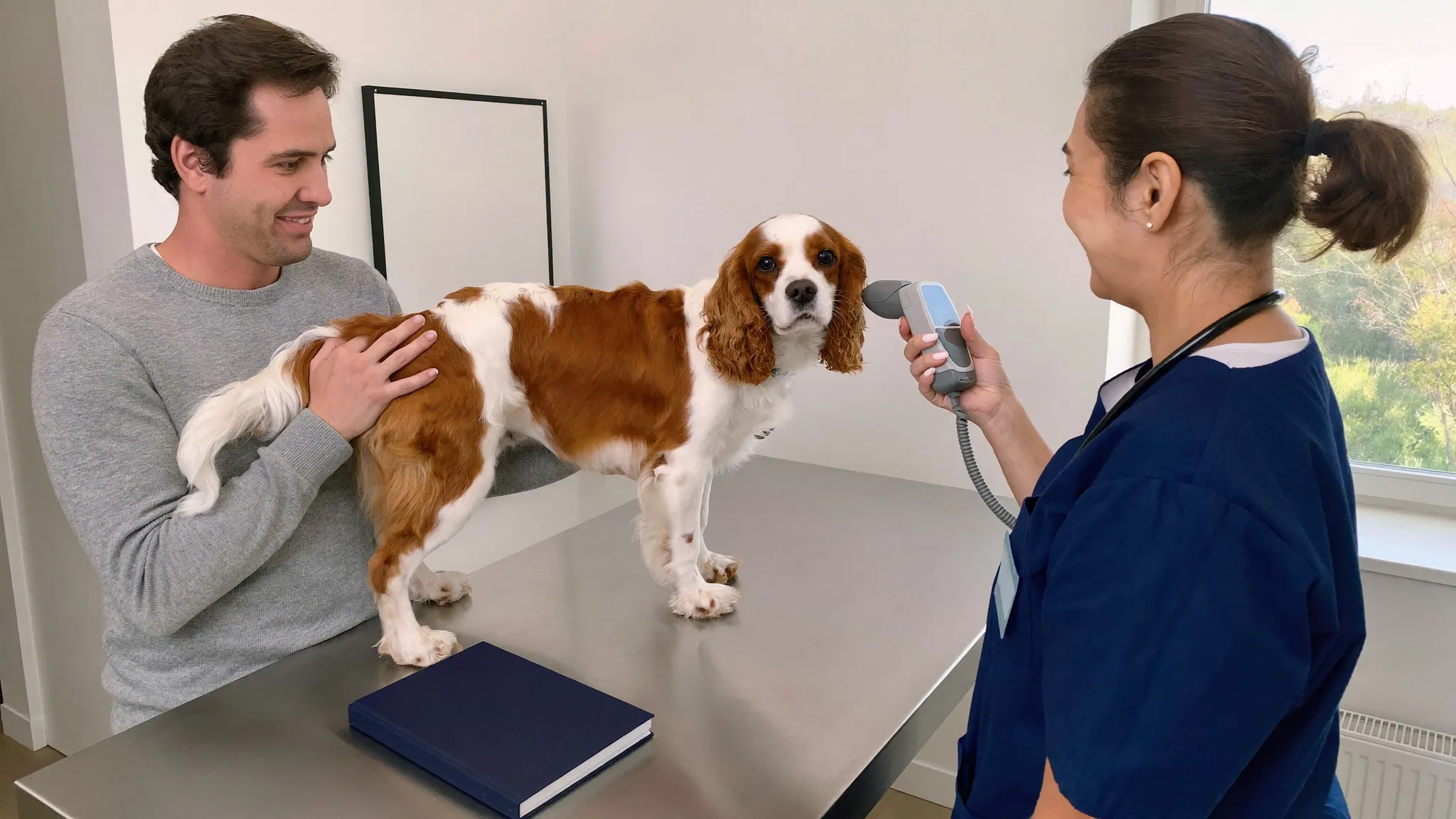
The pet passport and proof of rabies vaccination are the base of the file. For a dog leaving France, the rules are a microchip, a European pet passport issued by a vet, and a valid rabies vaccination. The order matters: the vaccination only counts if it was given after the identification.
The timings are fixed. The European Commission states that to be valid, your pet must have been microchipped before the vaccination is given, that it must be at least 12 weeks old for its first vaccination, and that you must then wait at least 21 days before travelling. The passport itself is only issued to owners resident in the EU, by any authorised vet, and it holds a description of the animal, its microchip or tattoo code and its health records. Our article The EU pet passport for dogs covers how to get one.
Three documents are added depending on where you are going.
- A tapeworm treatment for Finland, Ireland, Malta, Norway and Northern Ireland, given between 24 and 120 hours before entry and recorded in the passport.
- An animal health certificate if you are leaving Great Britain for an EU country. GOV.UK states that it is valid for 10 days for entry into the EU and for 6 months for onward travel and re-entry to Great Britain, and that you need a new one for each separate trip. Our article Taking your dog to the United Kingdom covers that route.
- The CDC Dog Import Form receipt for the United States, below.
Carry the originals, and keep a photo of them on your phone. The country-by-country conditions are on our travel requirements pages.
What does the United States require?
The receipt from the CDC Dog Import Form, which you show before boarding. The CDC states that the form should be completed by the person importing the dog into the United States, that you can print the receipt or show it on your phone, and that if the dog is travelling by air, you must show the receipt to the airline before boarding. You also need to be able to show it to U.S. Customs and Border Protection when the dog arrives.
How long it lasts depends on where you start. From a rabies-free or low-risk country, the receipt is valid for one dog to enter the United States multiple times from the same country, within six months of issue. From a high-risk country, it covers a single entry. Our article The CDC Dog Import Form, step by step and our United States travel requirements page set out the rest.
Can you take your dog’s food abroad?
Not freely: dog food is a product of animal origin, and it follows the customs rules for those products. Coming into the EU from a non-EU country, the European Commission is blunt: travellers are not allowed to bring in meat, milk or their products, with an exception only for less than 10 kg from the Faroe Islands or Greenland.
One door stays open for a dog: special pet feed required for medical reasons. It must weigh less than 2 kg and meet three conditions set out by the Commission: no refrigeration needed before opening, a packaged proprietary brand product for direct sale to the final consumer, and unbroken packaging unless in current use. The Your Europe page repeats that 2 kg ceiling for feed intended for the accompanying pet.
Inside the EU the rule is the opposite: you can carry meat or dairy products as long as they are for your own personal consumption, and the restrictions do not apply to products from Andorra, Iceland, Liechtenstein, Norway, San Marino or Switzerland either.
In practice, for a trip outside the EU, pack the rations for the journey rather than for the stay, and buy the rest on arrival. If your dog is on a particular diet, raise it with your vet before you go.
Do you have to declare dog food at customs?
Yes, and it is the simplest rule to remember. U.S. Customs and Border Protection requires that all travelers entering the United States declare meats, plants, animals and the plant and animal products they may be carrying. The declaration covers checked baggage, carry-on luggage and the vehicle, by ticking “Yes” on question 11 of CBP declaration form 6059B.
Skipping it has a price. The civil penalty for failing to declare agricultural items at U.S. ports of entry is 300 dollars for first-time offenders, and 500 dollars for a second violation. Declaring a bag of kibble costs nothing.
Importing animal food is also a matter of permits: the FDA states that generally, a USDA APHIS Veterinary Services permit is required for the importation of any animal food from countries with livestock diseases exotic to the United States. On the European side, undeclared meat and dairy products are confiscated and destroyed, and travellers may be fined or prosecuted.
Which carrier or crate should you take?
The one your dog can stand and lie down in without folding itself up. IATA, the airline industry body, asks for a container with enough space to turn about normally while standing, to stand and sit erect, and to lie in a natural position.
Its formulas start from the dog: length adds half the height of the dog’s legs to its body length, width is twice the width across the shoulders, and height is the standing dog plus the bedding. Those are internal dimensions, and snub-nosed breeds need a container 10% larger.
IATA also advises buying the container in advance, getting the dog used to being confined in it, and letting it become familiar with the crate a few weeks or months before departure. FECAVA, the Federation of European Companion Animal Veterinary Associations, asks for a travel-friendly crate or carrier that is secure, well-ventilated and comfortable, IATA approved for air travel, and familiar to the pet before the trip.
On scheduled flights, cabin carrier dimensions are set by the airline and are tighter than these formulas: our article Flying with a dog over 8 kg lists the published figures.
What goes on the collar and in the kit?
Two pieces of identification, says IATA: a permanent ID with your name, home address and telephone number, and a temporary travel ID with the address and telephone number where you or a contact person can be reached. It also asks owners to make sure the pet is properly identified, for example by microchip, and FECAVA asks for a sturdy collar with an identification tag in case the pet gets lost.
For the rest of the bag, FECAVA’s list is the one to follow, because it comes from vets: a bowl, the dog’s regular food, treats, grooming supplies, poop bags, familiar toys and a leash. It adds a sufficient supply of fresh water and a portable bowl for travel, and a stock of the necessary medications, regular treatments and first aid supplies included. The treatments themselves are decided with your vet, never alone.
All of it comes out of one appointment: FECAVA puts a thorough veterinary check-up before departure, covering vaccination status and updates, protection against parasites including destination-specific risks, and the legal requirements of crossing the border. It also asks for a list of emergency vet contacts at your destination, and accommodation that takes dogs, like the ones we gathered in Dog-friendly hotels in New York.
On the day, IATA advises reducing the quantity of food the day before but giving the dog enough water; our article Toilet breaks, water and food on a flight covers the rest. For the drive to the airport, FECAVA asks for rest stops and exercise breaks, and says never to leave your dog unattended in the car.
What if the paperwork were checked before departure?
That is what our brokers do: they check every dog’s file before departure. Entry requirements still apply on every flight, private ones included, so nothing exempts you from the passport, the microchip and the vaccination.
Loulou Air is a brand of AEROAFFAIRES, a private aviation broker since 1991, selling Pay-per-Seat private jets for your dog and you: you pay for your seat, not the jet, and each ticket covers one person and their dog. Your dog flies in the cabin with you, never in the hold, and stays at your feet for the whole flight. There is none of the weight limit imposed by scheduled airlines: capacity depends on the aircraft and on the number of animals on board, and a broker confirms every dog case by case. On board, the crew is briefed on welcoming animals, and water, bowls and blankets are provided, which lightens the bag you carry.
Our flights serve New York, Dubai and Los Angeles: see our open flights. We open new routes every month, so tell us where you want to go, and speak to a broker about your dog’s file. For a whole aircraft, our sister company AEROAFFAIRES arranges full charters.
Frequently asked questions
What documents does a dog need to travel abroad?
Leaving France: a microchip, a European pet passport issued by a vet, and a valid rabies vaccination given after the identification. Depending on the destination, add a tapeworm treatment, an animal health certificate, or the CDC Dog Import Form receipt for the United States.
Can you take dog food on a plane?
For the journey itself, yes, within whatever your airline allows as baggage. The border is the real constraint: coming into the EU from a non-EU country, meat, milk and their products are not allowed, and only special pet feed required for medical reasons passes, under 2 kg and in unbroken packaging. Entering the United States, every food item must be declared.
How far ahead should you start?
At least three weeks for the rabies vaccination alone, since it only counts 21 days after a primary dose. FECAVA puts the veterinary check-up before everything else. For a country outside the EU, allow more.
Sources
Rules change: check them against these sources before every trip.
- European Commission — About personal imports
- European Commission, Your Europe — Taking animal products, food or plants with you
- European Commission, Your Europe — Travelling with pets and other animals in the EU
- GOV.UK — Taking your pet dog, cat or ferret abroad
- service-public.gouv.fr — Travelling abroad with a pet
- CDC — Dog Import Form and Instructions
- U.S. Customs and Border Protection — Bringing Agricultural Products into the United States
- U.S. Customs and Border Protection — Prohibited and Restricted Items
- FDA — Importing Animal Food
- IATA — Traveling with pets
- FECAVA — Checklist for pet owners before traveling with your pets