Dog jet lag: how to help them adjust
Dog jet lag: what the research actually measures, and how to reset meals, walks and sleep to local time without forcing anything.
By the Loulou Air team · · 8 min read
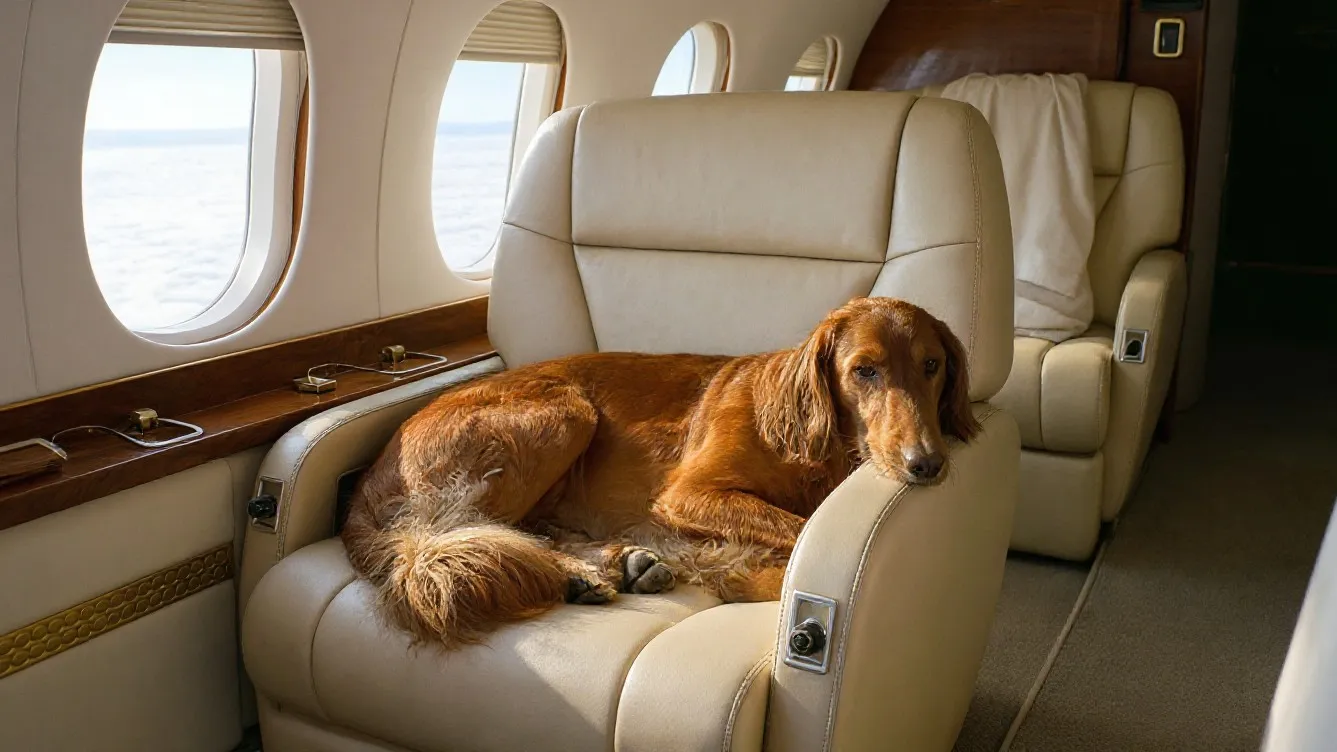
Your dog does not read the time off a phone, but it reads yours: what organises its day is the hour you get up, walk it and feed it. Cross a few time zones and you are not really shifting its internal clock, you are shifting yours, and it follows you. Here is what veterinary research actually measures, and the simple steps recommended by the AVMA, the MSD Veterinary Manual and the major animal welfare charities. On a long flight one detail shapes everything else: whether your dog spends those hours at your feet in the cabin, as it does on Loulou Air flights, or alone in the dark and the noise of the hold.
Do dogs get jet lag?
Nobody can say a dog experiences jet lag the way you do, but its daily schedule is certainly disrupted. What research does measure is that a dog’s activity locks onto the timetable of the humans around it.
A 2025 study in PLoS One fitted accelerometers to 25 sled dogs and 29 caregiver-companion dog pairs to record activity before and after the autumn Daylight Saving Time change. Among companion dogs, the result was clear: no change in morning activity based on sunrise times, either side of the clock change. The authors write that dogs are highly entrained to human behaviour.
In other words, the companion dogs had not set themselves by the sun. They had set themselves by their owners. For anyone travelling, that is good news, because it identifies the one lever that genuinely works: your own schedule.
What sets a dog’s body clock?
Two main cues, and they do not carry equal weight: light, and your habits. In the PLoS One study, the sled dogs followed their handler’s arrival time rather than the sun, and the companion dogs did not follow daybreak.
Light does act, but only partly. A 2008 study in Comparative Medicine exposed five beagles to a six-hour delay in the time the lights came on. Only the serum triglyceride rhythm responded, shifting by roughly four hours; the rhythms of total lipids, cholesterol and phospholipids changed neither in their peak time nor in their robustness.
The same study shows how much feeding matters: those rhythms disappear in food-deprived dogs. Meal times are not a minor detail in a dog’s day.
Keep the order in mind: your schedule first, meals next, light last.
Should you shift meal times before you leave?
If you want to prepare your dog, do it gradually, and talk to your vet first. The MSD Veterinary Manual, a standard veterinary reference, notes that it is best to introduce changes gradually where possible, and that establishing a routine can greatly help anxiety.
For the day of the flight itself, the feeding question is not one for a blog to settle. In its official brochure, the AVMA asks owners to talk to their veterinarian about whether and when to feed a pet before, during and after air travel. The answer depends on your dog, its age and its health.
One point is not up for debate: do not change the food itself. The RSPCA warns that changing a dog’s diet suddenly can cause stomach upsets and advises keeping to the usual diet, so pack enough for the whole trip. The AVMA says the same about any ongoing medication: bring everything your dog will need, and do not count on getting a refill while away.
What should you do on arrival day?
Put your dog on local time as quickly as you can, by putting yourself on it. This is the most consistent advice across veterinary sources: the AVMA recommends, while travelling, maintaining your regular routines for feeding and for toilet opportunities.
In practice, four anchors are enough.
- Meals. Dogs Trust suggests feeding your dog at the same times you would at home, with those times now read off the local clock.
- Walks. The RSPCA advises keeping to your dog’s routine so that food, exercise, bed and toilet breaks fall at around the same time every day.
- Sleep. Dogs Trust notes that most dogs need, on average, 16 to 18 hours of rest or sleep a day, and that this should be planned into your schedule. A dog that sleeps a great deal on the first day may simply be making up its total.
- Light and quiet. To re-establish a disrupted day-night cycle in an older dog, the MSD Veterinary Manual advises interacting with the dog during the day, providing a consistent place and time for sleeping, increasing its exposure to light during the day, and darkening the room at night. None of that costs anything to apply at any age.
Add something that smells of home. The RSPCA suggests putting a familiar-smelling item you have brought in your dog’s bed, or somewhere it will spend a lot of time.
How long does a dog take to adjust?
The veterinary sources cited here give no adjustment time for a new time zone, so treat rules of thumb such as “one day per hour of difference” with suspicion: nothing published for dogs supports them.
The only duration measured in this research concerns a change of human schedule, not of time zone: in the PLoS One study, the sled dogs took one day to adjust to a change in their handler’s arrival time. That is an encouraging hint, not a promise.
So watch your dog rather than count days, and raise the question with your vet before you go. The PDSA advises speaking to your vet well in advance of a trip, adding that your vet can also tell you whether it is safe for your pet to travel at all.
What should you watch for after a long flight?
Run a health check every day, and compare against what you know of your dog. The AVMA recommends a daily health check while away from home and warns that in unfamiliar surroundings a pet’s appetite, energy and behaviour may change.
That is exactly the difficulty: those signs look like ordinary travel tiredness and like a medical problem. The AVMA is unambiguous about what to do, and says to visit a local veterinarian if you are concerned about any physical or behavioural change. The PDSA adds that many pets find changes in routine, changes of environment and travelling itself stressful.
No medication, no calming product and no supplement should be given on your own initiative. The AVMA asks owners to consult their veterinarian before any tranquiliser or sedative, because these can increase the risk of heart or respiratory problems and are generally not allowed by airlines.
The flight matters as much as the time difference
Before worrying about time zones, look at how your dog will travel: that often decides the state it arrives in. The welfare charities are blunt about scheduled flights. Dogs Trust explains that most dogs cannot be gradually introduced to plane travel and will therefore likely find flying stressful, and says it would not advise air travel. The PDSA notes that with most airlines, all pets except guide dogs and recognised assistance dogs travel as cargo rather than in the cabin with their owner.
Two pieces of AVMA advice apply to every departure: exercise your dog before entering the airport if it is fit to do so, and put a familiar toy or blanket in its bag or crate, which helps a pet feel more comfortable.
One case deserves particular care. The AVMA points out that short-nosed pets such as pugs are more at risk than others of overheating and breathing problems during travel, and especially air travel. We cover this in Flying with a snub-nosed dog.
For the rest of your preparation, see our guides Keeping your dog calm on a flight, Preparing your dog for an eight-hour flight and Toilet breaks, water and food on a flight. If your dog is getting on in years, Flying with an older dog is the companion piece to this one.
Could your dog cross the time zones at your feet?
Yes, on a flight where it stays in the cabin with you from take-off to landing. That is the principle behind Loulou Air, an AEROAFFAIRES brand and a private aviation broker since 1991: Pay-per-Seat private jets for your dog and you. You pay for your seat, not the jet, one ticket covers one person and their dog, and your dog stays at your feet for the whole flight, in the cabin with you and never in the hold, with none of the hours of separation in the dark and the noise. There is none of the weight limit imposed by scheduled airlines, because your dog does not travel in the hold: capacity depends on the aircraft and the number of animals on board, and a broker confirms every dog case by case. Boarding is through a private aviation terminal with no queues, the crew is briefed on welcoming animals, and water, bowls and blankets are provided on board. A flight departs as soon as its seat threshold is reached; if it is not, the flight is cancelled, your seat is refunded in full and a broker offers you another date. See our open flights, or talk to a broker, who will go through your dog’s file with you, bearing in mind that we open new flights every month and that for a whole aircraft our sister company AEROAFFAIRES arranges full charters. Entry requirements still apply in every case, private flights included, and are set out on our travel requirements pages.
Frequently asked questions
Do dogs feel jet lag?
No veterinary source lets anyone state that they do. What is measured is that a dog’s activity locks onto its humans’ timetable: the 2025 PLoS One study found no change in companion dogs’ morning activity related to sunrise. In practice it is their schedule that is shifted, not necessarily their perception of it.
Should you wake your dog to put it on local time?
Nothing in the sources cited here requires it, and sleep gets made up: Dogs Trust notes that most dogs rest or sleep an average of 16 to 18 hours a day. Work instead on what you control, the timing of meals, walks and bedtime, and leave your dog its rest.
Can you give a dog melatonin for jet lag?
Do not give any product on your own initiative. The AVMA asks owners to consult their veterinarian before any tranquiliser or sedative, since these can increase the risk of heart or respiratory problems. Only your vet can judge what suits your dog.
Sources
Rules change: check them against these sources before every trip.
- PLoS One (2025) — The impact of Daylight Saving Time on dog activity
- Comparative Medicine (2008) — Daily Rhythms of Serum Lipids in Dogs: Influences of Lighting and Fasting Cycles
- MSD Veterinary Manual — Normal Social Behavior in Dogs
- MSD Veterinary Manual — Behavior Problems of Dogs
- American Veterinary Medical Association — Traveling With Your Pet (2023 brochure)
- RSPCA — Taking your pet on holiday
- Dogs Trust — Taking your dog on holiday
- PDSA — Our top tips for travelling with pets